A collaborative blog project addressing themes from our Anthropology class: Food, Culture and Politics, by looking at the history of Caribbean food.

Tuesday, December 6, 2011

Jamaican Food: More Than Just the Jerk


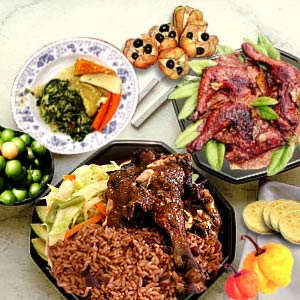
Jamaican cuisine is the heart and soul of the country, they love their food. Their cuisine is deeply connected with the islands diverse heritage and Jamaica's citizens have daily rituals surrounding its consumption. They usually start the day with a dish called callaloo and their next meal, lunch, is the biggest meal of the day. “Islanders draw from many West African and Indian dishes, and staples from those cultures such as dukunnu (pudding made from cornmeal, green banana, yam, sugar, and spices then wrapped in banana leaves and steamed) and curried goat are mainstays in Jamaican cuisine as well”(“Jamaica Food” n.d.). Curry and jerk aren't the only seasonings used in island dishes. Allspice, ginger, nutmeg, and dried pimento berries can be found in many recipes.

The Jamaican people adopted foods like cassava, from the indigenous Arawak, pickled meats and fish, from the European influence, bananas and yams, from the Africans and curry, from the people of East India. Then they “add some more spice, and what do... [they] get? Jamaican cuisine”(“Visit Jamaica” 2011). Jamaicans have a diverse history and a proud culture. Their cuisine and traditions around food reflect that. As the Jamaican proverb goes: a hungry man cannot work. So they know the value of a good meal.


Works Cited
"Jamaica Food." Jamaica Guide - Culture, History, Vacations, Travel, and More . N.p., n.d. Web. 3 Dec. 2011. <http://jamaica-guide.info/food/>.

"Visit Jamaica." About Jamaica Culture. N.p., 2011. Web. 3 Dec. 2011. <http://www.visitjamaica.com/about-jamaica/culture-food-mainpage.aspx>.

Just Jamaica: A Brief History

The early inhabitants of Jamaica, prior to Christopher Columbus's contact in 1494, were the Arawaks. A race of agriculturists, they also made quality textiles and pottery. Christopher Columbus named the island Santiago (Saint-James). However, the name was never adopted, most likely because it was boring in comparison with the original Arawak, name Xaymaca. The name Jamaica is merely a corruption of Xaymaca.("A Brief History" n.d.)  

                                                                                                                      The Spanish arrival decimated the indigenous peoples. Large numbers of them were captured and sent to Spain as slaves, others were used as slaves in Jamaica, and many were killed by the Spaniards. By 1665 There were no Arawaks left, but enslaved Africans were replacing them. In 1645 the British captured Jamaica from Spain, but the former Spanish slaves refused to surrender and escaped to the mountains, repelling all attempts to capture them. These escaped slaves are the early ancestors of the Maroon people found in Jamaica today. The name originates from the Spanish phrase cimarron, meaning wild.("A Brief History" n.d.)


Spain formally ceded Jamaica to Britain in 1670. The Royal Africa Company was formed 2 years later and used Jamaica as its chief market. This led to the island becoming a center for slave trading in the West Indies. Nonetheless, the Maroons managed to successfully retain their freedom and, in 1740, British authorities acknowledged their rights to freedom and property.("A Brief History" n.d.)


Settlers, employing slave labor, developed cocoa, indigo, sugar and later coffee estates. By the time of the Napoleonic wars, Jamaica had become very prosperous exporting both sugar and coffee. However, after the wars ended sugar prices dropped, and the slave trade was abolished in 1807. Slaves were emancipated in 1834 and the plantations began employing indentured Indian and Chinese laborers. One of the reasons that Jamaican culture and food is so diverse is the slave trade. Jamaica has a heritage comprised of all different ethnic origins. In the second half of the 19th century the banana industry was established, on big estates and smallholdings. After a long history of ownership by colonial powers Jamaica eventually gained it's independence in 1962. At first with bauxite, a mineral readily available in Jamaica, in high demand, tourism flourishing and a revival in bananas Jamaica's economy prospered.("A Brief History" n.d.) However, due to the International Monetary Fund, Jamaica is now struggling to survive. The Jamaican people, so heavily reliant on agriculture in the past, now must rely on tourism. Most of the food is imported to the island even though there are many farmers capable of growing crops to sustain the country. After the Jamaican currency was devalued, thanks to the International Monetary Fund, farmers could no longer afford to compete with imports. Now the country exists in oxymoron, the lavish hotels exist beside heart breaking poverty. More can be learned about Jamaica's current situation in the incredibly moving film, Life and Debt.  


Works Cited 
"Brief History of Jamaica." Guide to the Countries of the World: Nations Online Project. N.p., n.d. Web. 3 Dec. 2011. <http://www.nationsonline.org/oneworld/History/Jamaica-history.htm>.

Monday, December 5, 2011

Haiti... A Brief Primer


Haiti was first discovered by Christopher Columbus on December 5th, 1492. Spain had successfully colonized the island and devastated the indigenous Taino people. However, Spain's interests were primarily vested in the emerging gold market in the Americas which led the island's economy to grow slowly. French, English and Dutch settlers eventually inhabited the island, forming a pirate colony, Tortuga, that flourished by hunting Spanish ships and making good use of the island's ecological wealth. By 1664, the French West India Company took control over Tortuga, and France formally claimed control of the Western portion of the island "Hispaniola" under the Treaty of Ryswick.

In 1967, Haiti became the French colony of Saint-Dominique. The French imported slaves from Africa and grew cash crops such as indigo, tobacco, cotton and cacao. Its capital, Cap Francais, became known as the "Paris of the New World." Over the next century, the French colonists used whatever means were necessary to quell the burgeoning slave rebellions. The French Revolution played a major part in the colony's independence, as resources were primarily focused within France. By 1804, under the leadership of Jean-Jacques Dessalines, the rebels formally seized control of the island and restored its original name, 'Haiti' or, "Land of Mountains." Haiti successfully became the first free slave colony in the world.

Although the revolution formally ended slavery and the race hierarchy, the social and economic divisions deriving from the colonial regime strongly influenced post-colonial society. Former slaves simply refused to return to the plantations, opting instead for a subsistence based mode of production. As a result, the Haitian economy is sharply divided between peasant farmers concentrated in its interior and a wealthy "mulatto" elite who reside closer to the coast. The subsistence economy has resulted in unprecedented levels of deforestation; it is virtually impossible to find significant amounts of trees outside of two national parks. On Tuesday January 12th, 2010, things got a lot worse for Haitians. The epicenter of a massive 7.0 Mw earthquake struck 16 miles of Port-au-Prince. The Haitian government estimated 316,000 deaths, 300,000 injuries and 1,000,000 made homeless. The recovery effort is ongoing, and I urge anyone interested to donate to UNICEF or the Red Cross. It's a tendency for Westerners to be concerned only with what's on the news, and as Haiti disappeared from headlines so did much of its support. If you've got a few bucks, you might as well contribute. 
Haiti is a nation defined by domestic struggle, and has become the poorest nation in the Western hemisphere. Although Haitians have faced unprecedented strife at the hands of the developed world, the complex interplay of colonization and migration have led it to create incredibly unique culinary traditions. Haitian cuisine has been influenced by Spanish, French, African and even American dishes. Prior to Columbus' arrival, the indigenous Arawak and Taino cultivated fruits and vegetables such as guavas, pineapple, papayas, sweet potatoes and corn. Europeans introduced limes, mangoes, rice and sugarcane among other things. Africans brought okra, pigeon pees, ackee (red/yellow fruit) and a variety of spices. Most importantly, Africans introduced red beans and rice, which eventually became a staple of Louisiana's creole cuisine.

Haitian cuisine combines Creole and French styles of cooking, and the strong presence of pepper sets their flavor apart from other Caribbean cuisines. At this point, it's important to illustrate the dichotomy of Haitian cuisine. An overwhelming majority of Haitians have little to no access to food on a consistent basis; therefore they rely mostly on rice, corn, yams, and beans. Those fortunate enough to have more access to food flavor their dishes with a combination of peppers, garlics and herbs. Typical Haitian foods are characterized by the use of starch stables (i.e. corn, yams, millet, beans) however the more privileged Haitians make good use of lobster, shrimp, duck and French influenced desserts (mousse and pastries). In a nation marred by internal domestic strife and unprecedented levels of poverty, Haitians truly understand the value of quality cuisine.  


Unique Haitian Customs Surrounding Food


 Food security in Haiti is virtually nonexistent. The Haitian people starve simply because they cannot afford even the most basic nutritional staples. Contrary to popular belief, Haitians have an incredibly rich culinary tradition and fully understand the tenants of a proper diet. In fact, there is a wide variety of indigenous food categories that closely resemble Western proper nutrition discourse.
Haitian notions of health differ greatly from Western science. Although the majority of Haitians are Roman-Catholic, many prescribe to tenants of Voudou. Therefore, they rarely consult mental health professionals for psychological and emotional issues, and instead consult with family, clergy or Voudou practitioners. Many attribute such ailments to external forces (i.e. God, spirits) and therefore do not seek proper medical assistance.
 In times of mental distress, Haitians may offer feasts to please the Gods, who they believe may be responsible for their peril. Physical ailments are treated by consuming certain food and drinks. For example, Haitians believe that gas can be cured by consuming corn and plantains among a variety of foods common to the region.


In traditional Haitian culture, food is broken into six different categories. Hot, cold, acid, non-acid, heavy and light. In order to maintain good health, these properties must be in perfect balance. Physical illness is the result of an imbalance between these six categories, and relief is sought by consuming foods that have an opposite property than the illness. For example, Haitians feel that heavy food is energy-rich food. Therefore, feelings of lethargy may be alleviated after eating a dish termed "heavy". Some Haitians believe that citrus fruit causes acne, which is a primary sign of poor health in the region. Foods are classified on a gradual scale from cold to hot. Foods are often used to treat illness, and foods with the opposite properties of the illness are consumed.

Cold : avocadoes, cashews, mango, coconut, cassava
Fairly cold: lime, okra, bananas, grapefruit
Cool: tomato, sugar cane syrup, oranges, cantaloupe, chayote
Neutral: cabbage, conch, carrots, watercress, brown rice
Warm: eggs, pigeon, soup & bullion, pork
Hot: rum, nutmeg, garlic, tea, cornmeal mush


Haitians feel that eating enough to feel satisfied is eating well. In the West, the notion of eating implies a balanced meal with the recommended daily amount of vegetables, grains, dairy and protein. Most Haitians refuse to eat yogurt, cottage cheese and runny egg yolks. Traditionally, the largest meal of the day is lunch, and men are almost always served the choice portion of meat (if available). Between heads of households of the same generation, it is customary to exchange food, which is known as "to eat together". Brothers will send each other a pot of coffee or small portion of what they've cooked each day. There is no spirit of competition in the exchanging of food, as one sends however much s/he can afford to at the time.
After the disintegration of slavery in Haiti, the freed slaves wanted nothing to do with the large plantations owned by the wealthy mulatto. Therefore, small scale farms sprung up throughout the region. Rural nuclear families generally produce food independently, and divide up their land amongst their kin. 

Celebration..Haitian Style


The majority of Haitians are Roman-Catholic, although most prescribe to some elements of Vodou--an Afro-disporic faith unique to Haiti. Haitians celebrate Christmas and New Years, although only the more privileged can enjoy a Christmas tree. After midnight mass, the Roman-Catholics return home to feast and exchange gifts. Another national holiday is All Souls' Day, in which the deceased are honored through eating, drinking and exchanging stories. Many place food on the grave of the deceased or on table which they once sat. A variety of dishes are traditionally served on All Souls' Day, including fried pork or goat, pikliz (fried carrots and cabbage), Haitian bread and Pineapple Nog. These holidays provide the Haitians a time to imbibe and celebrate with loved ones, a practice that we all can relate to.


Carnival, held in Port-au-Prince is when Haitians get down, with the get down. It's also known as Fat Tuesday, and celebrated three days before Ash Wednesday the following week. It's essentially Mardi Gras minus the Sodom-esque qualities that Bourbon St. offers. You can rest assured that seedy strip club bouncers won't force you into their establishments during this rendition. In Port-au-Prince, everyone is having an awesome time drinking, dancing, wearing elaborate costumes and swaying to incredibly loud, and incredibly seductive Caribbean music. Beton St. provides a venue for loud music, floats and over a million people to party together. The party generally doesn't formally stop until 4 AM, but continues on throughout the night and into the next day. 

It is the most important annual musical event in Haiti, and its exuberance is saturated in political meaning. Many theorists believe that Carnival diverts popular attention away from oppressive social realities. It acts as a "pressurve valve", venting popular anger into symbolic, rather than material reversals. It is a fiercely anti-authoritarian festival; some may go so far as categorizing it as revolutionary. The throngs of people attract a variety of well known vendors, who peddle fresko (flavored ice), tablet pistach (peanut brittle) gwiyo (fried pork) and of course, clarien. With a variety of foods, flavors and people, Carnival is one event worth seeing. 


Believe it or Not.. Haitians Make a Damn Fine Moonshine


Clairin is the most popular beverage in Haiti and plays a pivotal role in the day to day lives of Haitians. It's a drink for the people, by the people, and is impossible to find outside of Haiti.. Unless of course, it comes into the hands of a resourceful exporter. It's the Haitian equivalent to moonshine, distilled from molasses and served to the masses. Haiti used to be the largest sugarcane exporter in the world, however today the majority of it is imported. Most of the sugar grown in Haiti today is used exclusively for the production of clairin. It is distilled twice in order to increase its potency. It's usually sold in small used bottles that once held some rum from the neighboring Dominican Republic. It comes in a variety of strengths and colors, from white, bright red , green or caramel brown. It's rarely ever aged before bottling, and most bottles have a variety of unidentified objects resting at the bottom. Stills are located throughout the countryside, and can fill a gallon for around 100 Haitian Gourdes, or about $2.50. One could procure a bottle of clairin virtually anywhere, including roadside stops. It's considered the drink of the poor , and considering that most of Haiti is poor, one can assume that most Haitians imbibe a fair share of clairin.
Pretty sweet deal. Unfortunately, I was not able to bring any clairin to class but it's relatively easy to make on your own. In the spirit of legality I couldn't possibly encourage a group of bright undergrads to make Haitian moonshine, but any resourceful UVM student could do so with relative ease. When distilling moonshine, one could use either a pot or a reflux, the first being much cruder and easier. Below is a brief guide in preparing clairin using a pot:


1. Dissolve the proper ratio of sugar and molasses* into water
2. Bring to a boil
3. Wait for it to cool down to 110' Fahrenheit
4. Add more sugar/molasses
5. Let it ferment for a few weeks. If mixture is bubbling, give it more time.
6. Pour the mixture into a pressure cooker to 173' Fahrenheit
7. Fasten Copper pipe to pressure cooker, and open end to another container
8. Filter it through charcoal
9. Enjoy

Note: To the experienced moonshiner, the molasses ingredient may seem familiar. It's the active ingredient in the rum distillation process. I'm not exactly sure how clairin production differs from that of rum.

You have just read the most brief, most crude recipe for clairin, or moonshine, anywhere on the internet. I would not recommend that anyone follows this recipe. People often die after drinking moonshine prepared the wrong way. Luckily for Haitians, there is no shortage of experts. This drink is generally not much stronger than your average bottled spirit, however if its distilled enough times it can be almost 100% pure. We've been saturated with the benefits of eating local, maybe it's time to start drinking local too. In Haiti, clairin provides an alternate source of necessary income for its producers. It's not explicitly illegal to make either. However, here in the USA it is incredibly illegal. It's probably not a good idea to apply for a license to sell clairin on Church St., so procuring a bottle of clairin may be best suited for the prospective Caribbean traveler. 

Sharing Sancocho and Other Dishes


Dominican Cake

In the Dominican Republic, food is used as a way for people to gather and spend time together. Sunday is the day when these meetings occur. Often times, people show up to a house without any sort of planning. Instead of being thought of as rude and intrusive, the impromptu host is glad that the guests have come to share their company. At this point, the traditional Sancocho dish is made and eaten (Visiting the Dominican Republic).  During the week, lunch is the largest meal consumed and everyone comes home to enjoy it. But, supper is also eaten as a family and is not served until all family members are home from school and work (Morris and Ismail 40). This creates a very family oriented atmosphere that is important to the Dominicans. There is also a large street food culture. One of the most common made is the pateslito, which is essentially a savory meat turnover (Morris and Ismail 41).  Some families eat out at restaurants , but if you want something quick, many frequent the colmados, which serve as both a grocery store and a bar. Either you can gather ingredients quickly for the meal you wish to prepare or grab a quick drink with a friend (Clammer, Grosberg, Porup 68). To celebrate any sort of family occasion, a Dominican cake is made. “There are three parts to it. First, there is the very rich cake, and then comes the equally rich pineapple filling. The cake is then topped with a caramel-infused meringue”(Albala 123). Because of the time and effort put into the creation of the cake, it is seen as a sort of labor of love, hence why it is for special family occasions (Albala 123).  Overall, the Dominicans think of food as being an agent for bringing loved ones together.


References
Albala, Ken. “Dominican Republic”. Culture of the World Encyclopedia. California: ABC-CLIO, LLC, 2011.

Clammer, Paul, Michael Grosberg, and Jens Porup. Dominican Republic and Haiti. California: Lonely Planet, 2008.

Morris, Kerry-Ann, and Nafisah Ismail. Dominican Republic. Wisconsin: Gareth Stevens Publishing, 2004.

Visiting the Dominican Republic. Ruth Ramos, Esther Ramos, and Al G. Smith. 2005-2011. 1 December 2011. < http://www.visiting-the-dominican-republic.com/food-of-the-dominican-republic.html>.